

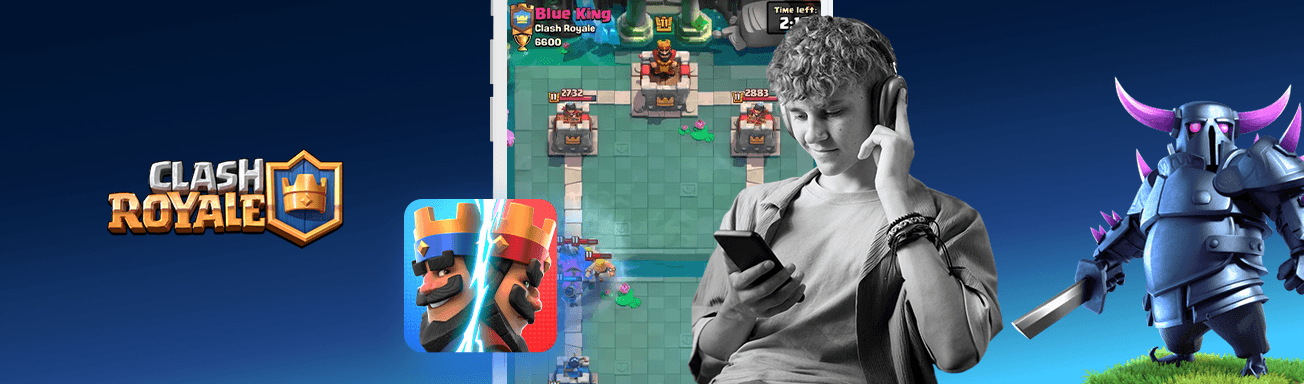
Clash Royale is a fast-paced, highly competitive mobile game enjoyed by players worldwide. In our latest report, the game was the 2nd most popular game among kids (behind Roblox), with them playing for an average of 23 minutes per day.
The game blends elements of digital card collecting, tower defense, and real-time strategy, and is free for kids to download on the App Store (9+) and Google Play Store (15+).
What can kids do on Clash Royale?
The objective of the game is for players to win head-to-head battles to destroy their opponents’ towers. Beforehand, you must build your deck of 8 cards representing “troops” (characters that do the fighting), spells, and defensive buildings. During the fast-paced, 3-minute battles, you spend “elixir” dragging and dropping these cards onto the battlefield to destroy opposing towers while defending your own.
The main game mode is the 1v1 ladder (“Trophy Road”), where players earn trophies and progress through a series of themed arenas, unlocking new cards and gameplay features as they advance.
As well as special challenges and limited-time game modes, Clash Royale offers 2v2 battles, where players can team up with a friend, a “Clanmate”, or a random partner to fight against another duo. 2v2 battles are more casual and low-stakes than the 1v1 ladder, as players don’t lose hard-earned trophies if they lose.
Deck-building is another key part of the game. Between battles, players can select any 8 cards from their collection to form their deck. Players can earn cards through gameplay, purchase them from the in-game shop, or request them from other members of their Clan.
What are “Clans” in Clash Royale?
Clans are the social hub of the game – a player-created team or community of up to 50 people. Clan members can chat with each other in what is effectively a group chat, request and donate cards, play penalty-free practice matches, and work together to battle other Clans for massive reward chests in Clan Wars.
For players serious about progressing in the game, joining a Clan is practically mandatory.

Clash Royale: The risks
In-app purchases
As Clash Royale is free to download and play, its developer, Supercell, relies heavily on in-game purchases – effectively making the game “pay-to-win,” as upgrading a deck of cards to a competitive level without paying can take months.
Many young players will not have the patience to wait to build a strong deck, and this, combined with pressure from friends and Clanmates, can lead to children racking up massive credit card bills if app store purchasing limits aren’t locked down.
“Gacha” and gambling-like mechanics
To progress in Clash Royale, players must strengthen their deck. To acquire cards, they need to open reward chests, which can be earned through gameplay or obtained using “gems” purchased with real money.
Chests in Clash Royale are forms of loot boxes – in-game prize systems that utilize “gacha” (randomized reward) mechanics. Loot boxes, and other in-game gacha-style reward systems, have been criticized for their likeness to gambling, and their potential to lead to problem gambling – particularly amongst kids and teens who can be less risk averse, and more sensitive to dopamine hits from gambling wins.
Excessive screen time
Clash Royale has clever ways to keep kids hooked and coming back for more. As matches are only 3 minutes long, and packed with dopamine-spiking competition, players can easily slip into the “one more” trap and lose track of time. “Clan Wars” can put kids under even more pressure to play at times they shouldn’t (like during study time or bedtime) so they don’t let their friends down or risk getting kicked out of their Clan.
When players win a match, they’re rewarded with a chest that can be unlocked after a specified amount of real-world time (often 3 to 8 hours). This effectively trains kids to constantly check their phones throughout the day to see when they can next unlock their rewards.
Gamer rage and “tilt”
Many fast-paced, competitive mobile games can cause a player to “lose it”, but Clash Royale seems to have a particularly bad reputation for gamer rage. Losing several 1v1 matches in a row, making small but costly mistakes, facing opponents with significantly stronger decks (which may be have been “unfairly” bought rather than earned), losing when only one victory away from reaching a new arena or league, and, of course, being taunted by opponents, can all cause players to spiral into rage.
“Tilt” is also common amongst players of Clash Royale. Tilt is a psychological state in which frustration causes a player’s decision-making and performance to deteriorate. Research has shown tilt as a cycle where poor performance leads to negative emotions, which then cause even poorer decisions and more losses.
A tilt cycle in Clash Royale might look like this:
- Lose a match
- Feel frustrated or angry
- Immediately play another game to “win the trophies back”
- Make rushed or emotional decisions
- Lose again
- Become more frustrated and angry
- Repeat.
Toxic chat
While Clash Royale doesn’t have direct 1-on-1 messaging, Clan chats are effectively group chats where kids can be exposed to inappropriate language, strong trash talk, or bullying – especially when players get into a gamer rage.
Clash Royale does provide automated profanity filters and players can report inappropriate messages, but toxic behavior can still slip through.
4 ways to make Clash Royale safer for kids
1. Set up a Supercell ID Family (if available)
Supercell introduced Supercell ID Family, which allows parents to manage up to 8 Young Player Accounts (accounts for under 16s) and monitor their use of Supercell games – including Clash Royale and Brawl Stars.
While it can help parents keep tabs on their kids’ gaming behavior, Supercell ID Family is not a replacement for parental controls – parents can’t use it to limit screen time or block the app from being opened, for example.
At the time of writing, Supercell ID Family is in a testing phase, and not yet available to all players.
2. Block or limit in-app purchases
Clash Royale might be free to play, but winning often comes at a real-world cost. To stop kids racking up large credit card bills by buying gems and strengthening their decks, parents should consider blocking in-app purchases through the appropriate app store – or at least requiring approval before any purchases are made.
3. Turn on Profanity Filter and join Family Friendly Clans
Parents can enable (or recommend their child enables) the Profanity Filter in settings, to hide or censor offensive words in Clan chats. Joining a Family Friendly Clan applies stricter chat filters to reduce exposure to inappropriate language.
4. Use parental controls
Parents who are concerned about their kids spending too much time playing Clash Royale – or spending too much money – can consider using comprehensive parental controls, like those offered by Qustodio.
With Qustodio, parents can:
- See how much time your child spends playing Clash Royale.
- Set daily time limits and schedule screen-free times, such as for study or bedtime.
- Block the Clash Royale app from being opened.
- Receive an alert when they first open the game.
- Pause the internet at the push of a button.
Clash Royale is a fun, fast-paced mobile game loved by kids all over the world. While there is no direct messaging or adult content in the game, there are still several things parents should be aware of, including in-game spending, gambling-like mechanics, group chat, and concerns about excessive screen time.
To ensure teens don’t spend all their time and money on the game, we recommend that parents block or limit in-app purchases, and use external parental controls to set healthy screen time boundaries.

